






MEDIA
Screens and video

EDITORIAL
Analysis
INTRODUCTION
After the resounding success of titles like Abu Simbel Profanation , West Bank or Camelot Warriors , Army Moves can be considered as the game that definitively launched Dinamic to the international market - and when we say international, we say England. So much so, that Dinamic distributors in the islands at that time -Ocean / Imagine- were in charge of converting the game to systems that were not too popular in our country -Atari ST, Amiga and Commodore 64-.
The game was initially programmed for Spectrum by the great Víctor Ruiz, one of the founding members of Dinamic. Later he made the versions for Amstrad CPC and MSX, starting from the original. It was put on sale at the end of 1986, reaching an immediate critical and public success. Subsequently, the already mentioned British versions were made, and finally the version for PC computers was released in 1989, being a mere direct conversion of the original program.
In 1988, what would be another great success for the Madrid company was programmed: Navy Moves, the second part of this magnificent game, the third part of the saga, the Arctic Moves.
Upon reaching the end of the latter, the imminent appearance on the market of what would be the fourth part of this successful saga, Desert Moves, was announced, a game that finally did not even begin, as commented Luis Mariano García, the Arctic Moves programmer.
THE GAME
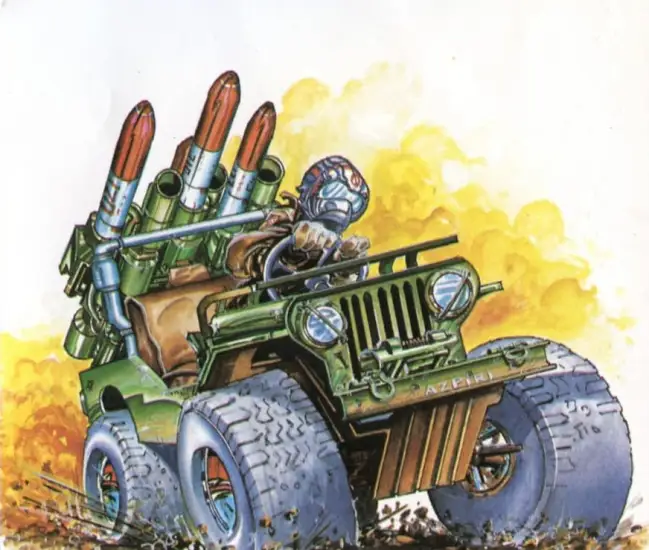
Most of you - at least the veterans - will know the love of the guys at Dinamic for making games divided into two parts (Game Over, Game Over II ...), and this Army Moves could not be an exception (it seems that with the exception of the ST and Amiga versions). In the first phase we will control a jeep, which is equipped with two types of projectiles; We will use them on the ground to defend ourselves from enemy jeeps, while the aerial ones will be used to destroy the numerous helicopters that fly over the skies of the stage.
The action takes place over an endless bridge, which is cut off at various points as a result of the ongoing war conflict. To avoid falling through these many points, you will have to keep your reflexes sharp and jump at the right moment, if you want to have any chance of saving your lives and carrying out the mission successfully.
Later, and after successfully completing your journey, you leave the jeep to go on to pilot a helicopter, which will be your means of transportation for the rest of the phase. If you manage to reach the end, you will be given a password that will allow you to play the second phase. In it, you leave the controls of the jeep, and you enter a totally different adventure. On foot, counting on your submachine gun and some grenades as weapons, you must infiltrate the enemy lines (the enemies number in the hundreds), and you must keep your cool if you want to reach the end of the game, which we can assure you that it will be nothing easy.
COMMENT
The first Dinamic games that came to my hands were Game Over and Basket Master -I bought both on the same day at El Corte Inglés-, so I came to this world just after the game that concerns us made its appearance. In fact, until then - well, until I bought the Fist II, which was my first commercial game - I had been wandering between "Videospectrums" and "Load'n runes", and would not be aware of its success until quite some time later. The first contact with the Army I had it in the form of a copy -now you can say :-D-, when a friend passed it to me. I would be lying if I said that I was hooked and fascinated, because it was not like that. I thought it was a simple and unattractive game, so I didn't pay much attention to it - which was certainly helped by the fact that I didn't spend a penny on it.
The passage of the years, as I have said many times, helps to clarify ideas and put things in their place. This is how I later began to appreciate the true value of this game: its high and almost indescribable addiction. Game after game I was forming a more realistic opinion, being able to confirm today that it is a true masterpiece of programming.
After the resounding success of titles like Abu Simbel Profanation
, West Bank or Camelot Warriors , Army Moves can be considered as the game that definitively launched Dinamic to the international market - and when we say international, we say England. So much so, that Dinamic distributors in the islands at that time -Ocean / Imagine- were in charge of converting the game to systems that were not too popular in our country -Atari ST, Amiga and Commodore 64-.The game was initially programmed for Spectrum by the great Víctor Ruiz, one of the founding members of Dinamic. Later he made the versions for Amstrad CPC and MSX, starting from the original. It was put on sale at the end of 1986, reaching an immediate critical and public success. Subsequently, the already mentioned British versions were made, and finally the version for PC computers was released in 1989, being a mere direct conversion of the original program.
In 1988, what would be another great success for the Madrid company was programmed: Navy Moves, the second part of this magnificent game, the third part of the saga, the Arctic Moves.
Upon reaching the end of the latter, the imminent appearance on the market of what would be the fourth part of this successful saga, Desert Moves, was announced, a game that finally did not even begin, as commented Luis Mariano García, the Arctic Moves programmer.
THE GAME
Most of you - at least the veterans - will know the love of the guys at Dinamic for making games divided into two parts (Game Over, Game Over II ...), and this Army Moves could not be an exception (it seems that with the exception of the ST and Amiga versions). In the first phase we will control a jeep, which is equipped with two types of projectiles; We will use them on the ground to defend ourselves from enemy jeeps, while the aerial ones will be used to destroy the numerous helicopters that fly over the skies of the stage.
The action takes place over an endless bridge, which is cut off at various points as a result of the ongoing war conflict. To avoid falling through these many points, you will have to keep your reflexes sharp and jump at the right moment, if you want to have any chance of saving your lives and carrying out the mission successfully.
Later, and after successfully completing your journey, you leave the jeep to go on to pilot a helicopter, which will be your means of transportation for the rest of the phase. If you manage to reach the end, you will be given a password that will allow you to play the second phase. In it, you leave the controls of the jeep, and you enter a totally different adventure. On foot, counting on your submachine gun and some grenades as weapons, you must infiltrate the enemy lines (the enemies number in the hundreds), and you must keep your cool if you want to reach the end of the game, which we can assure you that it will be nothing easy.
COMMENT
The first Dinamic games that came to my hands were Game Over and Basket Master -I bought both on the same day at El Corte Inglés-, so I came to this world just after the game that concerns us made its appearance. In fact, until then - well, until I bought the Fist II, which was my first commercial game - I had been wandering between "Videospectrums" and "Load'n runes", and would not be aware of its success until quite some time later. The first contact with the Army I had it in the form of a copy -now you can say :-D-, when a friend passed it to me. I would be lying if I said that I was hooked and fascinated, because it was not like that. I thought it was a simple and unattractive game, so I didn't pay much attention to it - which was certainly helped by the fact that I didn't spend a penny on it.
The passage of the years, as I have said many times, helps to clarify ideas and put things in their place. This is how I later began to appreciate the true value of this game: its high and almost indescribable addiction. Game after game I was forming a more realistic opinion, being able to confirm today that it is a true masterpiece of programming.
Version ranking
Es difícil destacar una versión sobre el resto, por lo que me limitaré a incidir en sus características y diferencias principales. Por un lado podemos situar las versiones programadas en España, y por otro las que fueron realizadas por los chicos de Imagine.
En lo que se refiere a las primeras, la base de todas ellas es la versión de Spectrum. Partiendo de la casi total similitud, destaca el mayor colorido de la versión Amstrad CPC, la pobre conversión realizada para PC (clavadita a las de 8 bits, con el agravante de estar programada en 1989), y la diferencia!! entre la versión de Spectrum y la de MSX en su primera fase (el jeep es blanco en Spectrum y verde en MSX, lo que no es mucho, pero algo es).
Respecto a las versiones inglesas, destaca la música, común a las tres versiones. Se trata de la melodía de la película "El Puente sobre el Río Kwai", utilizada también en aquel añorado programa de Emilio Aragón llamado "Ni en Vivo ni en Directo". Cabe mencionar que en las versiones de 16 bits, la música la compuso el muy conocido Dave Wittaker. En lo que respecta a las versiones en sí, la de Commodore 64 está muy bien realizada, así como las otras dos, destacando la versión de Amiga por su mayor calidad en gráficos (a pesar de ser un juego antiguo, no son iguales a los de Atari) y música (esto ya era más normal por aquel entonces).
CREDITS
Development team
Programa: Víctor Ruiz Tejedor
Gráficos: Víctor Ruiz Tejedor, Santiago Morga Bachiller
Música: Manuel Cubedo
Versión PC: Victoriano Gómez
Pantalla de carga: Javier Cubedo
Ilustración: Alfonso Azpiri
Versión C64: Zach Townsend
Gráficos C64: Andrew Sleigh & Jane Lowe
Música & FX C64: Fred Gray
View full credits Gráficos: Víctor Ruiz Tejedor, Santiago Morga Bachiller
Música: Manuel Cubedo
Versión PC: Victoriano Gómez
Pantalla de carga: Javier Cubedo
Ilustración: Alfonso Azpiri
Versión C64: Zach Townsend
Gráficos C64: Andrew Sleigh & Jane Lowe
Música & FX C64: Fred Gray
AROUND THE GAME
Links and presence











DISCOVER
Related games














COMMUNITY
Latest comments
Me vicié en cuanto vi la carátula. Me lo regalaron en mi 14º cumpleaños y tras dos parones (que supongo que serían por exámenes) me lo terminé en la tercera oleada de jugar compulsivamente... y vaya decepción de final!!! Aún así seguí jugando a él hasta deshacerme del 6128, allá por 1996. El tintineo de la banda sonora aún resuena en mi cabeza Puede ser que haya llegado el momento de un más que merecido revival?
2021-04-20 21:04:31 02 NevillePara la versión PC: con DOSBox va demasiado rápido en casi todas las configuraciones, así que cycles=220, que equivale a un PC XT con CPU 8088 a 4.77 Mhz. o como mucho, cycles=550, equivalente a un PC AT con CPU 80286 a 6 Mhz.
2016-08-02 16:00:30 03 jonnyceutaRODRIGO, quizas en la concepcion de ir disparando y saltando obstaculos si que tenga cierto parecido el ARMY MOVES, con el MOON PATROL, pero por lo demas ahi terminan los parecidos. Graficamente ARMY MOVES es infinitamente superior inclusive su elevada dificultad.
2015-04-20 19:33:04 04 RodrigoDespués que un amigo me hizo un comentario, no tengo más que darle la razón. ¿Acaso la primera fase no está inspirada en Moon Patrol? Saltos, disparos al aire y tierra...
2015-04-11 15:49:22